

This website uses cookies
We use cookies to personalise content and ads, to provide social media features and to analyse our traffic. We also share information about your use of our site with our social media, advertising and analytics partners who may combine it with other information that you’ve provided to them or that they’ve collected from your use of their services.
Consent Selection
Details
  • Necessary cookies help make a website usable by enabling basic functions like page navigation and access to secure areas of the website. The website cannot function properly without these cookies.
    • Learn more about this provideropens in a new window
      cf.turnstile.uThis cookie is used to distinguish between humans and bots.
      Maximum Storage Duration: PersistentType: HTML Local Storage
    • Learn more about this provideropens in a new window
      CookieConsentStores the user's cookie consent state for the current domain
      Maximum Storage Duration: 1 yearType: HTTP Cookie
    • Learn more about this provideropens in a new window
      __cf_bmThis cookie is used to distinguish between humans and bots. This is beneficial for the website, in order to make valid reports on the use of their website.
      Maximum Storage Duration: 1 dayType: HTTP Cookie
    • XSRF-TOKENEnsures visitor browsing-security by preventing cross-site request forgery. This cookie is essential for the security of the website and visitor.
      Maximum Storage Duration: SessionType: HTTP Cookie
  • Preference cookies enable a website to remember information that changes the way the website behaves or looks, like your preferred language or the region that you are in.
    • We do not use cookies of this type.

  • Statistic cookies help website owners to understand how visitors interact with websites by collecting and reporting information anonymously.
    • Learn more about this provideropens in a new window

      Some of the data collected by this provider is for the purposes of personalization and measuring advertising effectiveness. The provider may use the IP Addresses for ads measurement and ads personalization.

      _gaRegisters a unique ID that is used to generate statistical data on how the visitor uses the website.
      Maximum Storage Duration: 2 yearsType: HTTP Cookie
      _ga_#Used by Google Analytics to collect data on the number of times a user has visited the website as well as dates for the first and most recent visit.
      Maximum Storage Duration: 2 yearsType: HTTP Cookie
  • Marketing cookies are used to track visitors across websites. The intention is to display ads that are relevant and engaging for the individual user and thereby more valuable for publishers and third party advertisers.
    • Learn more about this provideropens in a new window
      LAST_RESULT_ENTRY_KEY [x2]Used to track user’s interaction with embedded content.
      Maximum Storage Duration: SessionType: HTTP Cookie
      TESTCOOKIESENABLED [x2]Used to track user’s interaction with embedded content.
      Maximum Storage Duration: 1 dayType: HTTP Cookie
      yt-icons-last-purged [x2]Necessary for the implementation and functionality of YouTube video-content on the website.
      Maximum Storage Duration: PersistentType: HTML Local Storage
      ytidb::LAST_RESULT_ENTRY_KEYUsed to track user’s interaction with embedded content.
      Maximum Storage Duration: PersistentType: HTML Local Storage
      YtIdbMeta#databases [x2]Used to track user’s interaction with embedded content.
      Maximum Storage Duration: PersistentType: IndexedDB
      __Secure-ROLLOUT_TOKENUsed to track user’s interaction with embedded content.
      Maximum Storage Duration: 180 daysType: HTTP Cookie
      __Secure-YECStores the user's video player preferences using embedded YouTube video
      Maximum Storage Duration: SessionType: HTTP Cookie
      __Secure-YNIDUsed to track user’s interaction with embedded content.
      Maximum Storage Duration: 180 daysType: HTTP Cookie
      LogsDatabaseV2:V#||LogsRequestsStoreUsed to track user’s interaction with embedded content.
      Maximum Storage Duration: PersistentType: IndexedDB
      ServiceWorkerLogsDatabase#SWHealthLogNecessary for the implementation and functionality of YouTube video-content on the website.
      Maximum Storage Duration: PersistentType: IndexedDB
      VISITOR_INFO1_LIVETries to estimate the users' bandwidth on pages with integrated YouTube videos.
      Maximum Storage Duration: 180 daysType: HTTP Cookie
      YSCRegisters a unique ID to keep statistics of what videos from YouTube the user has seen.
      Maximum Storage Duration: SessionType: HTTP Cookie
  • Unclassified cookies are cookies that we are in the process of classifying, together with the providers of individual cookies.
    • _cms_langPending
      Maximum Storage Duration: 6 monthsType: HTTP Cookie
      _cms_xsrf_vPending
      Maximum Storage Duration: SessionType: HTTP Cookie
Cookie declaration last updated on 8/9/26 by Cookiebot
[#IABV2_TITLE#]
[#IABV2_BODY_INTRO#]
[#IABV2_BODY_LEGITIMATE_INTEREST_INTRO#]
[#IABV2_BODY_PREFERENCE_INTRO#]
[#IABV2_BODY_PURPOSES_INTRO#]
[#IABV2_BODY_PURPOSES#]
[#IABV2_BODY_FEATURES_INTRO#]
[#IABV2_BODY_FEATURES#]
[#IABV2_BODY_PARTNERS_INTRO#]
[#IABV2_BODY_PARTNERS#]
About
Cookies are small text files that can be used by websites to make a user's experience more efficient.

The law states that we can store cookies on your device if they are strictly necessary for the operation of this site. For all other types of cookies we need your permission.

This site uses different types of cookies. Some cookies are placed by third party services that appear on our pages.

You can at any time change or withdraw your consent from the Cookie Declaration on our website.

Learn more about who we are, how you can contact us and how we process personal data in our Privacy Policy.

Please state your consent ID and date when you contact us regarding your consent.

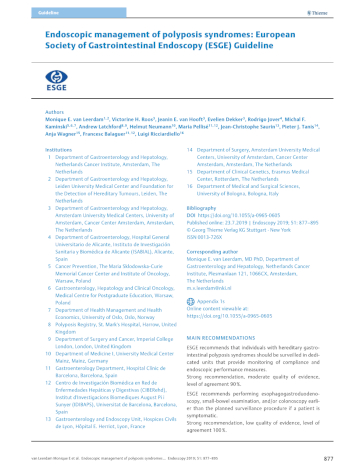
Endoscopic management of polyposis syndromes: European Society of Gastrointestinal Endoscopy (ESGE) guideline

Authors

Monique E. van Leerdam, Victorine H. Roos, Jeanin E. van Hooft, Evelien Dekker, Rodrigo Jover, Michal F. Kaminski, Andrew Latchford, Helmut Neumann, Maria Pellisé, Jean-Christophe Saurin, Pieter J. Tanis, Anja Wagner, Francesc Balaguer, Luigi Ricciardiello

MAIN RECOMMENDATIONS

ESGE recommends that individuals with hereditary gastrointestinal polyposis syndromes should be surveilled in dedicated units that provide monitoring of compliance and endoscopic performance measures.
Strong recommendation, moderate quality of evidence, level of agreement 90 %.

ESGE recommends performing esophagogastroduodenoscopy, small-bowel examination, and/or colonoscopy earlier than the planned surveillance procedure if a patient is symptomatic.
Strong recommendation, low quality of evidence, level of agreement 100 %.

INTRODUCTION

Colorectal cancer (CRC) is the fourth most incident cancer and is the second commonest cause of cancer-related death in Europe [1]. While the majority of CRC is sporadic, twin studies have shown that up to 35 % of CRC cases have a familial component [2]. Approximately 2 %– 5 % of CRC cases are genetically determined by mutations in the adenomatous polyposis coli (APC), MUTYH, DNA mismatch repair, or other predisposing genes [3].

Although hereditary CRC syndromes are rare, it is of great importance that clinicians recognize these syndromes so they can make appropriate management decisions for both the patient and their family members who may also be at risk. Because all patients with polyposis syndrome are at high risk of developing gastrointestinal (GI) malignancies, endoscopic surveillance and interventions are required to prevent the development of cancer or to detect cancer at an early stage. Currently, there is uncertainty about the surveillance intervals and optimal endoscopic management, and guidelines regarding polyposis syndromes are limited. Therefore, the aim of this evidence-based and consensus guideline, commissioned by the European Society of Gastrointestinal Endoscopy (ESGE), is to provide clinicians with a comprehensive overview of the management options regarding endoscopic surveillance and interventions for the most important polyposis syndromes, namely familial adenomatous polyposis (FAP), MUTYH-associated polyposis (MAP), Peutz-Jeghers syndrome (PJS), juvenile polyposis syndrome (JPS), and serrated polyposis syndrome (SPS) (overview shown in ▶Table 1 [4 – 28]).

There are several other polyposis-associated genes, including PTEN, GREM1, POLE/POLD1, and biallelic NTHL1, that will not be discussed in this guideline because of their low prevalence. A second guideline will focus on the endoscopic management of familial and hereditary non-polyposis syndromes.

DOI https://doi.org/10.1055/a-0965-0605
Endoscopy 2019; 51

© Georg Thieme Verlag KG Stuttgart · New York